

Guide: essential taxes for companies entering France
Expanding a tech or retail scale-up to France is a significant milestone that requires a clear understanding of the local fiscal landscape. While the French market offers a high-quality infrastructure and a talented workforce, navigating the various taxes is critical for a smooth transition. This guide breaks down the mandatory fiscal obligations to ensure your French subsidiary remains compliant and competitive from day one.
1. Corporate income tax (Impôt sur les Sociétés – IS)
The foundation of business taxation in France is the Corporate Income Tax (IS). Any subsidiary generated as a distinct legal entity (such as a SAS) is subject to this tax on its French-sourced profits.
Current rates and thresholds
As of 2026, the standard corporate tax rate is set at 25% for all companies. However, a reduced rate of 15% applies to the first €42,500 of profit for Small and Medium Enterprises (SMEs), provided the capital is fully paid up and at least 75% owned by individuals or companies meeting specific criteria.
Bridging the Gap: US GAAP vs. French GAAP
For an American parent company, the main challenge lies in the accounting transition. French tax authorities require financial records to be maintained according to French GAAP (Plan Comptable Général), which involves a different chart of accounts than US GAAP. Properly reconciling these standards is vital to calculate your taxes accurately and avoid penalties during audits.
Transition: While IS targets your profits, the next major tax impacts every transaction you make in the European market.
2. Value Added Tax (VAT / TVA)
Unlike the US Sales Tax, which is typically applied only at the final point of sale, the French Value Added Tax (TVA) is an indirect tax collected at each stage of the production and distribution chain.
Understanding the rates
The standard VAT rate in France is 20%. This applies to most commercial sales of goods and services. Reduced rates (10%, 5.5%, or 2.1%) exist for specific sectors such as basic food products, books, or certain medical supplies.
Import VAT and reverse charge
For retail scale-ups importing goods from the US, you must account for VAT at the border. However, France has simplified this process: the “autoliquidation” (reverse charge) of import VAT is now mandatory and handled directly on your monthly VAT return. This prevents a negative impact on your cash flow by removing the need to pay the tax upfront to customs.
3. Territorial Economic Contribution (CET)
The CET is a local tax that funds French regions and municipalities. It is composed of two distinct taxes: the CFE and the CVAE.
CFE (Cotisation Foncière des Entreprises)
The CFE is based on the rental value of the professional premises used by the company. It is due in every municipality where your company has a registered address or office as of January 1st.
CVAE (Cotisation sur la Valeur Ajoutée des Entreprises)
The CVAE is calculated based on the “value added” produced by the business. It is important to note that the French government has been progressively phasing out the CVAE to lower the tax burden on production and improve industrial competitiveness.

4. Payroll taxes and social contributions
In France, the cost of labor includes significant social contributions that function similarly to taxes used to fund the national social security system.
The role of URSSAF
Every employer must register with URSSAF to pay social contributions. These cover health insurance, retirement, and unemployment benefits.
- Employer contributions: typically range between 40% and 45% of the gross salary.
- Employee contributions: approximately 22%, which are withheld from the gross salary by the employer.
Additional payroll-related taxes
Several smaller levies are also calculated based on your total payroll:
- Apprenticeship tax: funds initial vocational training.
- Professional training contribution: funds continuing education for employees.
- Construction effort (PEEC): mandatory for companies with 50 or more employees to support social housing.
5. Incentives: The R&D Tax Credit (CIR)
While France has various taxes, it also offers one of the most generous tax incentive programs in the world for innovation: the Crédit d’Impôt Recherche (CIR).
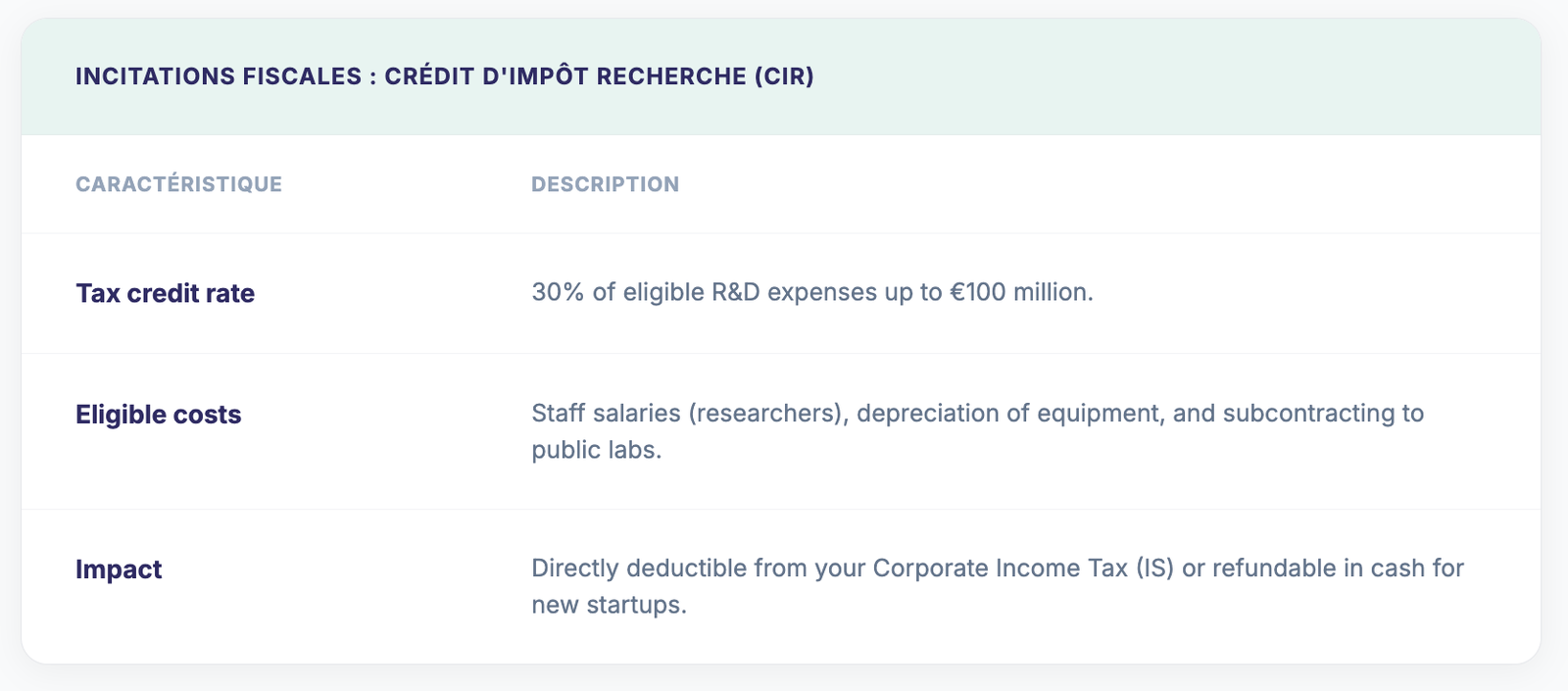
For a US tech company, placing a research hub in France can significantly offset the cost of high-level engineering talent through these tax savings.
6. International compliance and treaties
To prevent your profits from being taxed twice, you must leverage the France-USA Double Tax Treaty.
Dividend and interest flows
When your French subsidiary sends dividends back to the US parent company, the treaty generally reduces the withholding tax often to 0% or 5% provided specific documentation (Form 5000/5001) is filed.
Transfer pricing
As your group grows, any transactions between the US headquarters and the French branch (e.g., management fees, IP licensing) must be conducted at “arm’s length.” Failure to document these internal prices can lead to significant adjustments and additional taxes during a tax audit.
Conclusion
Successfully managing taxes in France is not just about compliance; it is about strategic planning. From utilizing the R&D tax credit to optimizing VAT flows, the French system offers tools that, when used correctly, support long-term growth for international scale-ups.