

Essential Taxes for Companies Entering France
Entering the French market is a strategic move that comes with real tax complexity. France offers world-class infrastructure, a highly skilled workforce, and strong consumer demand — but its tax system is layered, precise, and unforgiving of shortcuts. This guide gives executives a clear, practical picture of what to expect so your French subsidiary is compliant and well-structured from day one.
To kick off this tax overview, let us look at the most direct levy on your business earnings.
1. Corporate Income Tax (Impôt sur les Sociétés — IS)
Firstly, Corporate Income Tax (IS) is the starting point for understanding how France taxes business activity. Any subsidiary incorporated as a separate legal entity — the most common choice being a SAS (Société par Actions Simplifiée) — pays IS on its French-sourced profits.
Current rates and thresholds
In addition, the standard corporate tax rate is 25% across the board. A reduced rate of 15% applies to the first €42,500 of taxable profit for qualifying SMEs, but only when all three conditions below are met:
- Annual turnover is below €10 million (excluding VAT)
- The share capital is fully paid up
- At least 75% of the capital is held by individuals, or by companies that themselves satisfy these same conditions
Consequently, if you miss any one of these, and the standard 25% rate applies in full.
To sum up, the 15% rate and the €42,500 threshold are subject to change through annual budget legislation. Therefore, to verify if these thresholds have changed, you can consult the official French administration page or check with your advisor each year.
Reconciling US GAAP and French GAAP
Meanwhile, one of the first operational challenges for any American parent company is the accounting transition. In other words, French tax law requires financial records to be maintained under French GAAP (Plan Comptable Général), which uses a fundamentally different chart of accounts than US GAAP. Getting this reconciliation right from the outset is not a back-office detail — errors here flow directly into your tax calculations and can trigger penalties in the event of an audit. This is one of the first areas where Impulsa’s teams engage with incoming companies, ensuring the accounting framework is properly structured before the first tax return is due.
2. Value Added Tax (VAT / TVA)
Secondly, VAT is where many US executives hit their first major knowledge gap. Unlike US sales tax — collected once at the final point of sale — French VAT (TVA) is assessed at every stage of the production and distribution chain. Furthermore, every business in the chain charges VAT on its sales and recovers the VAT paid on its purchases, but the compliance requirements are ongoing.
Applicable rates
- 20% — standard rate, applying to the large majority of goods and services
- 10%, 5.5%, 2.1% — reduced rates for defined categories including basic foodstuffs, books, and certain medical products
Import VAT and the reverse charge mechanism
Companies importing goods into France must account for VAT at the border. France now requires the use of autoliquidation — the reverse charge mechanism — for import VAT. Rather than paying the tax upfront to customs and waiting for a refund, the VAT is simply reported and offset on your monthly VAT return. The cash flow impact is neutral by design.
3. Territorial Economic Contribution (CET)
Furthermore, businesses must also factor in regional obligations beyond national taxes. The CET is a local business tax that funds French regions and municipalities. It comprises two distinct levies.
CFE (Cotisation Foncière des Entreprises)
Calculated on the rental value of any professional premises your company occupies. It is assessed in every municipality where your company holds a registered address or operates an office as of January 1 of the tax year.
CVAE (Cotisation sur la Valeur Ajoutée des Entreprises)
Assessed on the value added generated by your business. The French government has been phasing this tax out in stages, with full elimination currently delayed to 2030.
The phase-out schedule has been revised multiple times through successive budget laws. You can track the official phase-out timeline on Service-Public.fr and confirm the rate applicable for your tax year with your advisor before filing.
4. Payroll Taxes and Social Contributions
Meanwhile, France’s employment cost structure is one of the most significant operational surprises for US executives entering the market. Social contributions — mandatory payroll-based levies that fund the national healthcare and pension systems — add substantially to the cost of every hire.
URSSAF registration
All employers must register with URSSAF, the government body responsible for collecting social contributions covering health insurance, retirement, and unemployment benefits.
- Employer contributions: typically 40% to 45% of gross salary
- Employee contributions: approximately 22%, withheld from gross salary by the employer
Rule of thumb: For every €100,000 gross salary on your payroll, budget a total employer cost of €140,000 to €145,000.
Additional payroll-based levies
- Apprenticeship tax — finances initial vocational training programs nationally
- Professional training contribution — funds ongoing employee training and development
- Employer Housing Contribution (PEEC — Participation à l’Effort de Construction) — mandatory for companies with 50 or more employees; a uniquely French obligation requiring employers to contribute to national social housing programs
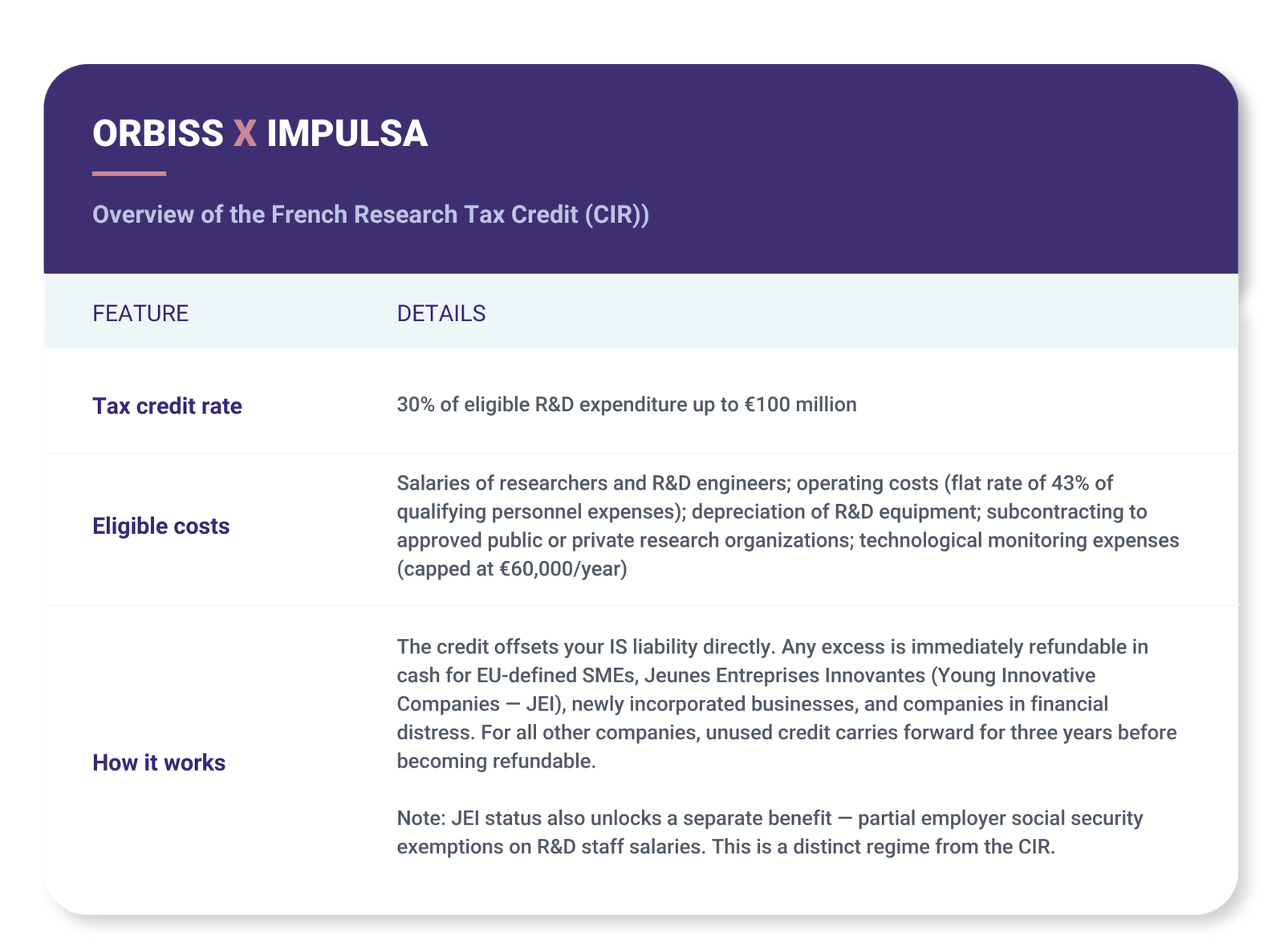
5. Incentives: The R&D Tax Credit (CIR)
However, France’s tax environment is demanding — but it pairs that with one of the most competitive R&D incentive programs in the world: the Crédit d’Impôt Recherche (CIR). For any company with a meaningful research or development function, this credit deserves serious attention during your market entry planning. Identifying and documenting eligible expenditures correctly is where many companies leave money on the table — and where Impulsa’s expertise in French R&D incentives makes a direct impact on your bottom line.
6. International Compliance and Tax Treaties
Consequently, as soon as your French subsidiary begins transacting with the US parent, two areas of international tax law require immediate attention.
Dividend withholding tax
When your French subsidiary distributes profits to the US parent, French law imposes a withholding tax on those dividends. The France–USA Double Tax Treaty reduces that rate — but the applicable tier depends strictly on your ownership structure:
- 0% WHT — the US parent must hold at least 80% of the French subsidiary’s voting rights for a minimum of 12 consecutive months and satisfy the Limitation on Benefits (LoB) clauses of the treaty. These conditions are strict and require deliberate legal structuring to achieve.
- 5% WHT — when the US parent holds at least 10% of voting rights
- 15% WHT — in all other cases
To claim a reduced rate, specific documentation must be filed with French tax authorities, including Form 5000 (certificate of tax residency) and Form 5001 (dividend-specific treaty exemption claim). Orbiss manages this process on the US side, ensuring the right structure is in place before your first dividend flows.
Transfer pricing
Any transaction between the US parent and the French subsidiary — management fees, IP licensing, intercompany loans, shared service charges — must be priced as if the two entities were unrelated parties. This is the arm’s length standard, and French tax authorities scrutinize it closely. The absence of contemporaneous transfer pricing documentation is itself grounds for a tax reassessment, independent of any underlying pricing dispute.
Conclusion
In conclusion, getting your French tax position right is not a formality — it is a foundation. Done poorly, it creates compounding risk across audits, intercompany transactions, and payroll compliance. Done well, it turns the French system into a genuine asset: the R&D tax credit can materially change the economics of building a team in France, and a properly structured holding arrangement can significantly reduce dividend leakage on repatriation to the US.
Impulsa handles the French side, Orbiss manages the US end. Together, they give your company a single coordinated team that understands both sides of the Atlantic.
If you are planning a French market entry or want your existing structure reviewed, reach out to ImpulsaxOrbiss for an initial assessment.